

There is most likely a cardboard box of VR headsets collecting dust somewhere in a middle school’s storage closet in central Pennsylvania. It’s likely that the foam padding is beginning to peel. If the charging cables were ever organized, they have long since become entangled in a knot that would be impossible for a substitute teacher to untangle. This is the low-key, unglamorous aftermath of one of the biggest technological bets ever placed on American education, and it provides you with nearly all the information you need to understand why teachers, the people the industry was supposed to support, never really materialized.
This was supposed to be a given based on the numbers. By 2023, head-mounted VR tools in education are expected to be worth more than $640 million, according to ABI Research analysts, and the overall AR market is expected to reach $5 billion. Prominent figures lined up early. Sony, Samsung, and Google. Oculus. During a period in 2016, almost every ed-tech conference featured a teacher putting a headset on a fifth-grader while the cameras were rolling. The footage was captivating. Students strolling among dinosaurs. soaring above the pyramids. permeating human cells. The promise seemed almost inevitable, like something out of a movie.
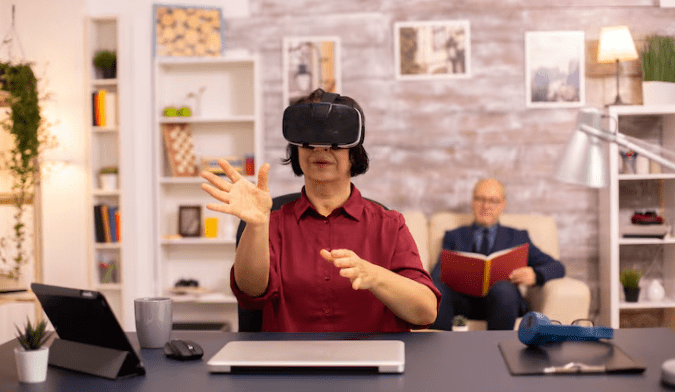
However, nearly ten years later, the real usage rate is almost comical. Even though 85% of teachers thought virtual reality could benefit students, only 2% of teachers were using it in the classroom, according to a widely cited industry survey. The true story is that gap between belief and behavior, and nobody in the industry seems to want to discuss it openly.
The causes are not enigmatic. The obvious one is cost. A $400 headset that needs to be replaced every few years was never going to be adopted by schools with patchwork budgets and outdated HVAC systems. However, there’s more going on. Teachers are skeptical of anything sold with a promotional video due to their temperament and training. Too many revolutions have come and gone. intelligent displays. Clickers. Every child should have a tablet. The cycle is well known.
The headsets are delivered in shrink-wrapped pallets, a vendor appears, a foundation writes a check, and then—nothing. The curriculum does not change to make room for the new toy. There is no rewriting of lesson plans. The U.S. Army Research Institute, of all places, stated quite bluntly that technology cannot be effective unless the curriculum is modified to accommodate it, but no one wants to alter the curriculum until the technology is proven. standoff.
The issue of VR’s true effects on kids is another. Despite not being a Luddite, Jeremy Bailenson, who oversees Stanford’s Virtual Human Interaction Lab, has cautioned that usage should be measured in minutes rather than hours. nausea. strained eyes. acute stress brought on by immersive media. According to Common Sense Media, 60% of parents expressed at least some concern about the potential health consequences. This type of discomfort exists in the staff room rather than during a quarterly earnings call.
It’s instructive to watch this unfold alongside the current AI craze. ChatGPT, Gemini, MagicSchool, and Skipper, the chatbot avatar wearing a backwards baseball cap, are currently competing with Pennsylvania districts. The same queries recur. Who is in charge of the data? The model was trained by whom? What happens to learning’s human component? Learning and education are not the same thing, as stated succinctly by Mike Soskil, a Wayne County teacher who has been involved in this since the days of classroom videoconferencing.
The VR wager was never entirely unsuccessful. It was an oddity. a feature that has no use case. Teachers were searching for a solution to a problem they didn’t truly have. Somewhere, the headsets are still for sale. Press releases continue to be sent out. On a Tuesday morning, however, you’ll find a teacher, a whiteboard, twenty-five agitated students, and an unapproved budget request for new copy paper in a typical American classroom. As it happens, the future is patient.
