

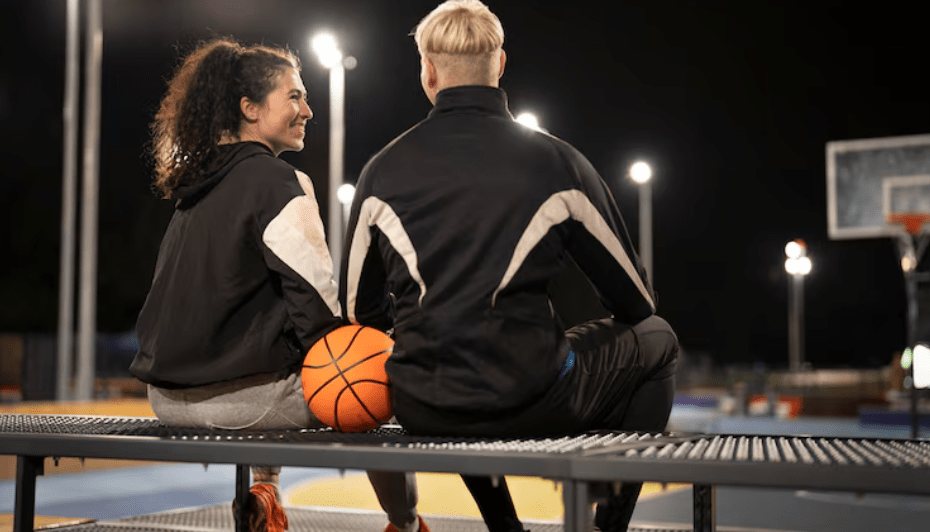
Seeing a high school football team practice at ten o’clock at night has a subtle surreal quality. Even in the absence of sunlight, the air remains dense and heavy, with moths circling the beams and field lights humming overhead. Parents wait while using their phones while seated in folding chairs along the sidelines. It doesn’t appear to be practice. It appears to be improvised. since it is.
Coaches are rescheduling all over the nation. Late at night, early in the morning, or occasionally both. The reasoning is straightforward and somewhat depressing: it is now medically unsafe to engage in outdoor sports during the middle of the day. Many high school athletes are currently navigating this summer, which is beginning to feel less like an anomaly and more like a new standard. Heat index values are rising above 100 degrees, turf temperatures can reach 160 degrees Fahrenheit, and overnight lows that hardly drop low enough for the body to recover.
During a webinar in July, Ashley Ward, the director of Duke University’s Heat Policy Innovation Hub, made a point that seems worth considering. She declared, “We’re not talking about a heat wave anymore,” following thirty days of intense heat. We are discussing a season. That framing is important. Heat waves are crises. Seasons are conditions that never change. Additionally, long-term circumstances necessitate long-term changes, which seem to include the high school sports schedule.
Young athletes are not little adults. That aspect is often disregarded. Compared to adults, children sweat less effectively and adjust to heat more slowly. Additionally, they are less likely to notice when something is amiss, such as when fatigue has escalated into a more serious condition or when thirst has turned into dehydration. Even after reading this statistic twice, it still seems shocking that heat-related illnesses rank among the top causes of death and disability among high school athletes, according to the CDC. The exposure is huge, with about 7.8 million high school athletes starting late-summer practice each year.
UNC Health’s pediatric emergency room treated kids with heat-related illnesses who came in from sports camps this past summer. “These are kids that are otherwise healthy,” stated the medical director of the department, Dr. Daniel Park. That particular detail sticks. not kids who already have health issues. Not kids who disregarded every caution. Healthy children, going about their summertime activities, ended up in emergency care because the temperature was just too high. J.J. Hoff, an emergency medicine specialist at Duke, called the summer “particularly busy,” citing record temperatures and an increase in heat-related cases.
When heat advisories are issued, football players receive the most attention, and for good reason. Heat is radiated upward from below by shoulder pads, helmets, padded uniforms, and synthetic turf. Even on a pleasant August afternoon, the environment is hostile. However, the soccer teams working through two-a-days on grass fields, the tennis players baking on asphalt courts, and the cross-country runners are all involved. Heat is not sport-specific.
According to Climate Central’s analysis of temperature data from 242 American cities, 88% of them have experienced an increase in the frequency of extremely hot days since 1970. Compared to the early 1970s, the majority of those locations now see at least one extra week of dangerously hot days. It’s not a rounding error. That represents a structural change in the nature of American summers and the expectations placed on those who spend them outside.
Particularly in athletic culture, there is a temptation to view heat tolerance as a character trait. Climate Central’s Andrew Pershing put it simply: machismo. The notion that you persevere, that hardship is training, and that whining about the heat is a sign of weakness. The origins of that mindset are deeply ingrained in sports. However, it’s becoming more and more difficult to reconcile with what emergency rooms and science are demonstrating. Your core temperature is not lowered by toughness. Water does. Shade does. The rest does.
How long coaches and athletic directors can continue to work around this issue is still unknown. Practicing at midnight is a workaround, not a fix. Additionally, Ward’s final observation from that July webinar bears the unsettling burden of straightforward math: it’s not irrational to believe that this could be “the coolest heat season of our lives.” At ten o’clock at night, the lights will continue to hum. The moths will continue to circle. A child who ought to be sleeping will be doing wind sprints on a hot field somewhere because that’s what summer turned into.
