

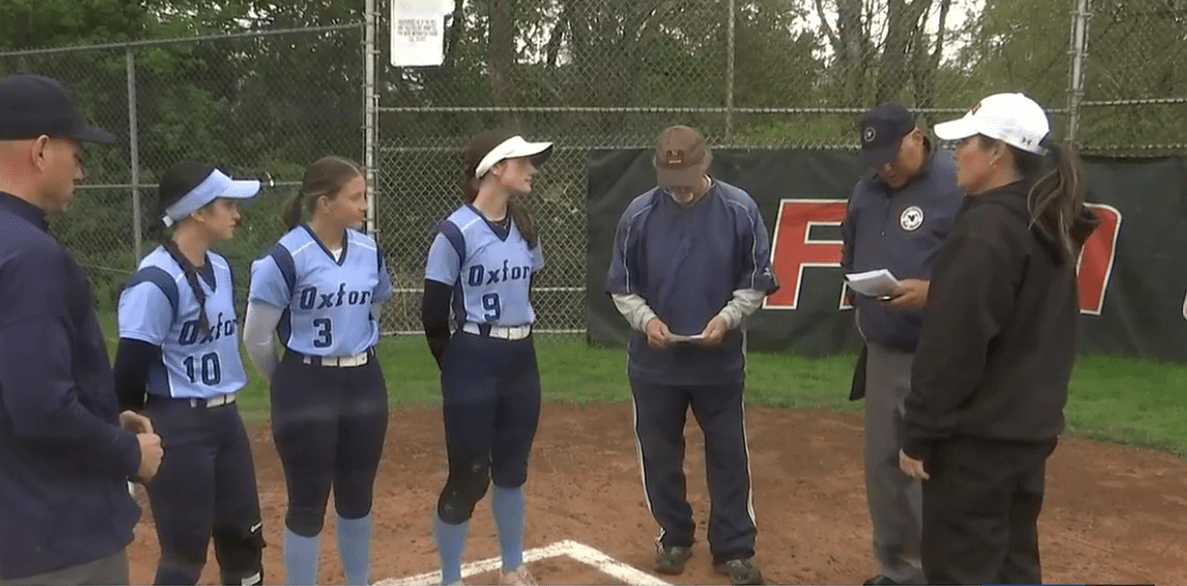
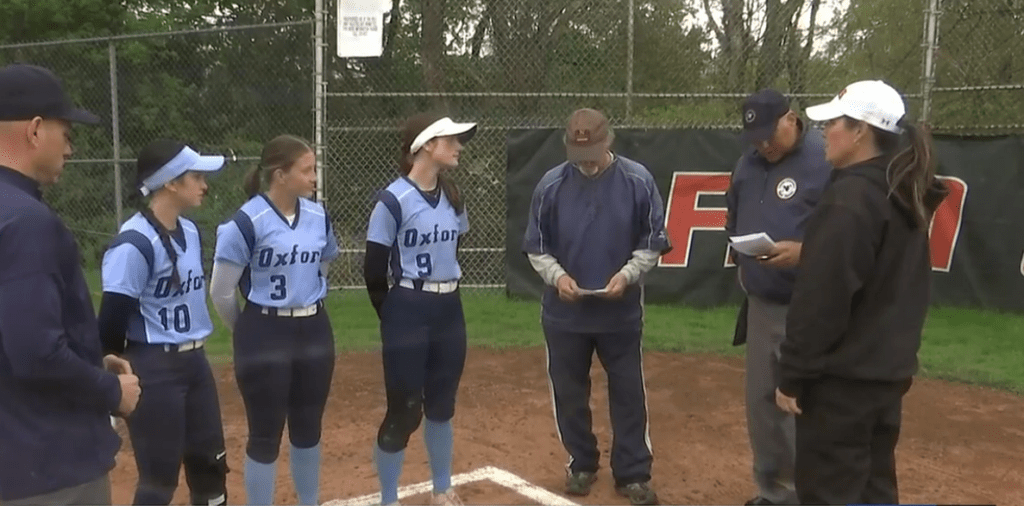
Every great athlete’s story has a point at which the numbers cease to be statistics and become proof of something more difficult to identify. The numbers for Jenica Matos, the pitcher from Cheshire High School who struck out 20 batters and gave up just one hit in a 10-0 victory over Oxford on May 1, exceeded that threshold long ago. The 20 strikeouts are impressive. When you realize that Matos lacks central vision, they change. What she sees, if you can call it seeing, is more akin to a pinhole than a rectangle when she stands in the pitcher’s circle and looks in toward the plate. She can hardly see the strike zone she so fully controls.
Outside of the medical community and the families it affects, Stargardt disease is not well known. About 1 in 10,000 people have this genetic eye condition, which is caused by a mutation that stops the retina from effectively removing harmful waste. Peripheral vision, light sensitivity, and a gradual dimming of detail at the center of everything you look at are what remain after the deposits build up over the macula, the area of the eye in charge of sharp, central vision. When Matos received her diagnosis, she was ten years old. In softball, her mother saw that she was striking out. It took some time for a local ophthalmologist to notice it. New Haven Hospital at Yale did. After returning home, the family sobbed.
With a 0.38 ERA, 300 strikeouts in 165.2 innings, three no-hitters, and a three-hit shutout in the championship game, she gave the Cheshire Rams their first CIAC Class LL title since 2016. When she started her senior year, recruiting calls had begun at midnight on September 1st, the first time Division I coaches were allowed to get in touch, and they continued well into the night. In November, she made a commitment to St. John’s University. It’s less than 100 miles from home, which is one of the reasons she chose it. She wanted her pitch to be seen by her parents.
Jenica Matos — Cheshire High School Softball — Key Facts & Profile
| Name | Jenica Matos |
| School | Cheshire High School, Cheshire, Connecticut |
| Team | Cheshire Rams softball |
| Head Coach | Kristine Drust |
| Position | Pitcher |
| Year | Senior (2025–26 season) |
| Diagnosis | Stargardt disease — rare genetic eye disorder affecting ~1 in 10,000 people; diagnosed at age 10 |
| Vision Status | Legally blind; no central vision; relies entirely on peripheral vision |
| Fastball Speed | Up to 64 mph (equivalent to low-90s baseball) |
| Height | 5 feet, 6 inches |
| 2024–25 Season Stats | 25-3 record; 0.38 ERA; 300 strikeouts in 165.2 innings; three no-hitters |
| CIAC Achievement | Led Cheshire to 2024–25 Class LL State Championship (first since 2016) |
| 2025–26 Early Stats | 60 strikeouts in 26 innings, zero runs allowed to start the season |
| Notable Performance | Struck out 20 batters, allowed 1 hit in a 10-0 win over Oxford (May 1, 2026) |
| Other Notable Game | Two-hitter with 25 strikeouts vs. No. 4 Amity, 1-0 in 11 innings |
| College Commitment | St. John’s University (D1) — committed November 2024 |
| Catcher / Battery Partner | Molly Fleming — wears white gear with orange duct tape and neon glove for contrast signals |
| Travel Team | Empire State Huskies 16U National |
| Awards | GametimeCT First Team All-State; CHSCA Player of the Year; CIAC Class LL Pitcher of the Year |
| Parents | Becky and Henri Matos |
In addition to being a study in problem-solving, Cheshire’s system around Matos is, in a way, exquisite in its specificity. Molly Fleming, the catcher, uses orange duct tape to mark target points on her white gear, providing Matos with a high-contrast object to focus on with her peripheral vision. The finger signals that Matos is unable to read from sixty feet away have been replaced by a bright neon glove that signals pitch calls against dark clothing. Coach Drust purchased gloves specifically for this use. The entire arrangement is spontaneous, purposeful, and incredibly successful. “It kind of just gives a point of view to look for my locations and my spots,” Matos replied. Throwing catches behind the plate during practice, Fleming no longer views the tape as out of the ordinary. It’s simply the way they operate.
Matos is genuinely challenging to write about because she defies popular narratives. Being someone’s inspiration doesn’t really appeal to her. She draws a clear distinction between her condition and her performance, but she has talked to younger athletes dealing with similar diagnoses, and those connections are important to her. “Even though I have an eye disease, it doesn’t really shape who I am as a player and a person,” she said in an interview with USA Today last year. “It’s my talent and how hard I work.” You wouldn’t be able to guess Matos’ story if you watched her pitch, according to Coach Drust. “You would never know,” Drust remarked. “And that’s what makes it even more spectacular.”
The record now includes the 20 strikeouts against Oxford. The Cheshire Rams have been unbeaten for the majority of the spring and were ranked first in Connecticut. Matos desires a second state championship. She wants to win the Gatorade Player of the Year award, which is a lofty but doable objective for a pitcher with her season. The version of her story that centers everything around the Stargardt diagnosis is what she does not appear to be very interested in. Observing her season from a distance gives me the impression that she has already made up her mind about who she is, and the illness is lower on that list than most people realize.
